
Territorial.io

Game info
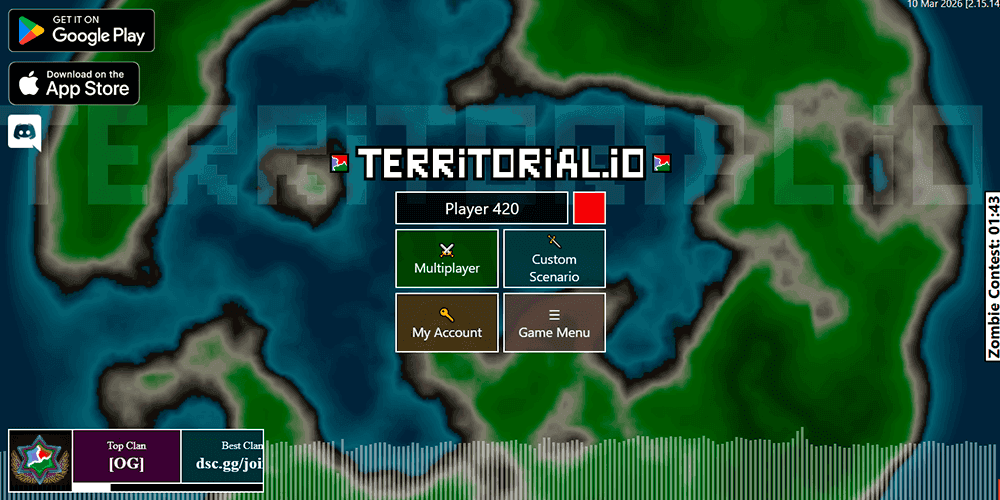
Territorial.io is the kind of game that tricks you with its appearance. Built by solo developer David Tschacher and released in 2020, it looks like a simple browser toy where colored blobs spread across a map. There is no flashy art, no elaborate tutorial, no cinematic intro. You pick a name, drop onto a map, and start painting territory. But within a few matches, the illusion of simplicity falls away. What sits underneath is a tense, surprisingly ruthless real-time strategy game where every percentage point of your resource bar matters and one mistimed attack can erase you from the board. The premise is clean: expand your territory, manage your single unified resource called Balance, outlast every other player and bot on the map, and be the last power standing. It is free, it runs in a browser or on mobile, and it is far more punishing than it has any right to be.
A Clever Strategy Loop Built on Balance and Timing
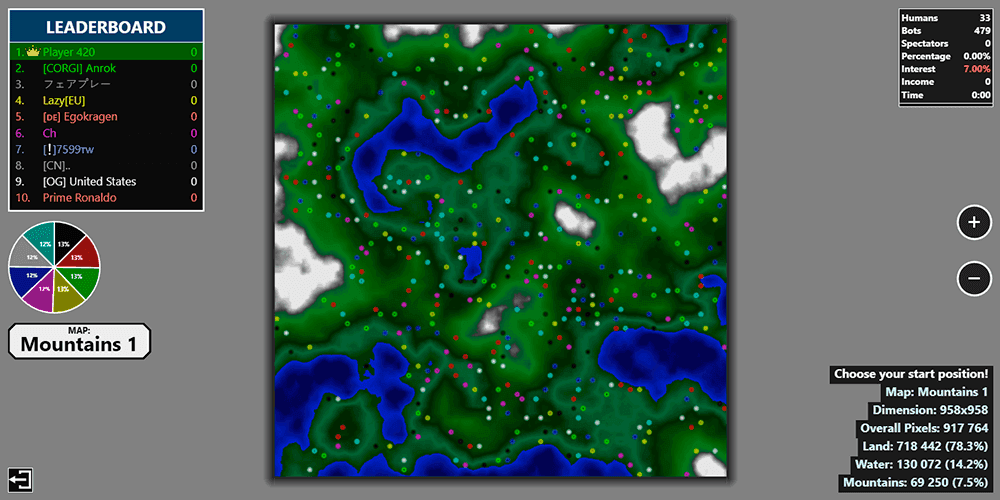
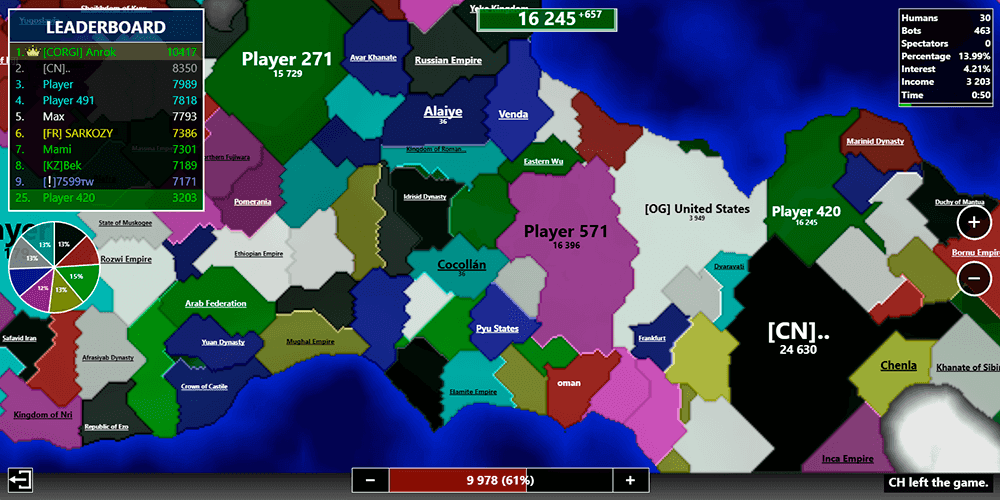
The engine driving every match is the Balance system. Unlike most strategy games that split economy, military, and defense into separate pools, Territorial.io rolls everything into one number. Your Balance is your army, your treasury, and your shield simultaneously. It grows through compound interest tied to how much territory you control — the more land you hold, the higher your interest rate, and the faster your Balance snowballs. Early in a match, this creates a land grab phase where efficient expansion is everything. Spending 50% of your Balance to flood into unclaimed space, then timing your troops to return home before the next interest tick pays out, is the difference between a commanding position and a slow death. Openings matter enormously. Aggressive players who full-send at 100% claim the most free land but leave themselves completely exposed if someone strikes during that window. Conservative players survive early pressure but fall behind in income.
Once borders close and empty land vanishes, the game shifts. Bots become the next target — they are essentially free territory if you wait for them to attack somewhere else and then hit them while their Balance is depleted. The defensive bonus in Territorial.io is roughly two-to-one, meaning an attacker loses about twice the troops the defender does. This single mechanic makes reckless aggression suicidal. The smart play is patience: keep your Balance high, watch your neighbors bleed each other, then strike the weakened survivor with a measured 20% attack. Boats add another layer, letting you launch naval strikes across water, though troop losses during transit make oversized fleets wasteful. Even something as basic as choosing which border to push carries weight, because attack speed scales with territory size, and reaching key chokepoints before an opponent can lock them out of entire sections of the map.
Diplomacy, Modes, and the Friction of Simplicity
There is no chat in Territorial.io. Communication happens entirely through emotes, truce requests, and the implicit threat of a full send. This constraint turns diplomacy into a guessing game layered with mind games. Clicking the handshake icon on a neighbor's territory proposes a truce — a gentleman's agreement with no enforcement. They might honor it for the entire match or break it the moment your Balance dips. Sending a skull emote to a player massing troops on your border can sometimes be enough to redirect their aggression elsewhere. Your chosen name even influences how others treat you. It is crude, limited, and surprisingly effective at generating drama.
Beyond the flagship Battle Royale free-for-all, the game offers 1v1 duels that reward pure economic efficiency, team modes for two to eight sides where donating Balance to struggling allies can swing an entire front, a Full Send Disabled mode that caps attack intensity and rewards steady positional play, and a Zombie mode that pits every human player against overpowered bots requiring genuine coordination. Different maps — from dense European theaters to open white arenas — reshape strategy each time.
The rough edges are real, though. Matches can feel repetitive once the core loop is internalized, because the phases of expansion, bot absorption, and player elimination follow a familiar arc. Spawn luck matters more than it should; starting boxed between aggressive human players while someone else spawns next to a continent of free land is a deficit that skill alone cannot always overcome. Team modes suffer when players leave and get replaced by erratic leaver bots, or when allies simply refuse to coordinate. The lack of any text chat means nuanced strategy with strangers is nearly impossible.
Still, Territorial.io finds its audience perfectly. Players who enjoy reading a board, managing risk, and outthinking opponents rather than outclicking them will find a game that delivers genuine tension from a single colored rectangle on a blank screen.