
Shark.io

Game info
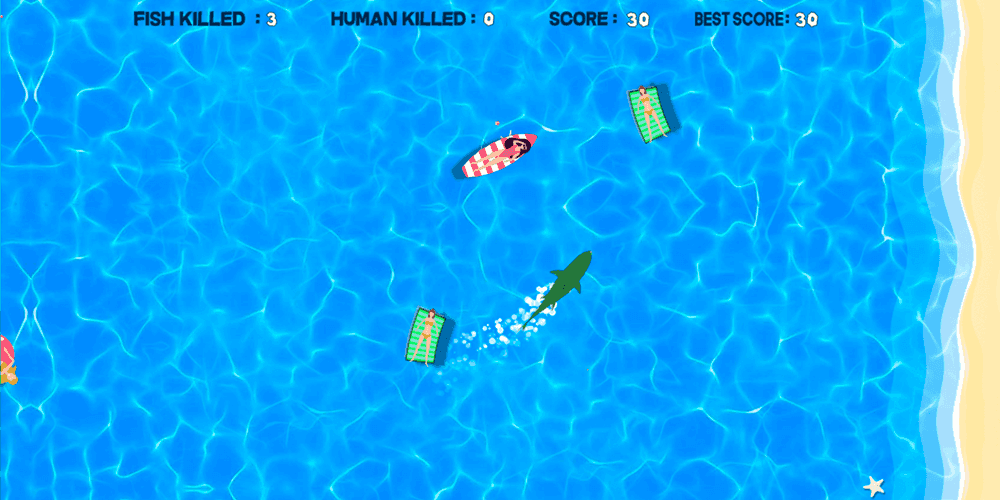
There is something immediately satisfying about loading up Shark.io for the first time. Developed by Tapinator, Inc. and released in mid-2016, the game drops you into a bright, chaotic underwater arena with one job: eat everything smaller than you and avoid everything bigger. It is a premise so lean it barely needs explaining, yet the moment you start swimming, the hook sets in fast. Matches are short, the controls take seconds to learn, and the ocean is packed with other player-controlled sharks all fighting for the same leaderboard real estate. Think of it as a colorful, arcade-flavored battle royale where the food chain is the only rule that matters. You start as a modest predator, gobble up AI fish and smaller rivals, and claw your way toward apex status — or get swallowed trying.
Fast, Simple, and Surprisingly Strategic
The core loop is textbook .io design: consume smaller prey, gain mass, climb the rankings, repeat. What keeps it tense is how quickly fortunes reverse. One moment you are comfortably mid-table, cruising through a coral reef and hoovering up fish. The next, a bigger shark bursts out of open water with a well-timed speed boost and you are gone. That boost mechanic is the game's secret weapon. A short tap gives you a burst of velocity useful for chasing down a kill, dodging a predator, or faking a direction change to bait an overeager rival into overcommitting. Managing your boost meter — knowing when to burn it and when to save it — is the thin line between a forgettable thirty-second run and a dominant session at the top of the board. Positioning matters too. Coral reefs and underwater caves offer cover for ambushes, while open water is a high-risk highway where speed is your only friend. It is worth noting that the exact feature set can differ depending on where you play. Mobile versions on iOS and Android may offer unlockable shark types, cosmetic skins, seasonal events, or even weapon-based variants like Sword Shark.io, while the browser build tends to be a leaner, more immediate experience. Treat any specific customization or mode as version-dependent rather than guaranteed across every platform.
An Underwater Arena That Knows Its Audience
Visually, Shark.io punches above its weight class for a free browser title. The 3D graphics are bright, clean, and cheerful — more Saturday-morning cartoon than nature documentary. Built on HTML5 and WebGL, it loads quickly, runs without plugins, and holds a stable frame rate even when the server is crowded with predators. On mobile the touch controls translate well; a virtual joystick handles movement while a dedicated button fires off the boost. The overall feel is closer to the direct, movement-based aggression of chasing and fleeing than to the slower territorial games that define parts of the .io genre. Where Agar.io rewards patience and splitting strategy, and Slither.io leans on trap-setting, Shark.io is about reading the water in front of you and reacting in real time. That action-forward design philosophy gives it strong replay value in short bursts. Chasing a new personal best or trying to dethrone the server leader is genuinely exciting for the first several sessions. Over longer stretches, though, the lack of evolving objectives or deeper progression systems means repetition can creep in. There are no elaborate tech trees like Deeeep.io or mission structures like the Hungry Shark series — just the raw scoreboard and whatever personal goal you set for yourself.
Who Shark.io Works Best For
Shark.io lands squarely in the sweet spot for players who want instant multiplayer action without installation screens, account creation, or tutorials. It is an ideal pick for younger audiences drawn to the shark fantasy but unbothered by the absence of graphic violence — eliminated sharks simply pop into collectible scraps rather than anything gory. Fans of lightweight browser competition who grew up on Agar.io and Slither.io will find familiar DNA here, wrapped in a more kinetic, predator-themed skin. The game also works as a surprisingly effective quick-session palate cleanser between heavier titles. Its greatest strength, however, is inseparable from its ceiling. The simplicity that makes Shark.io so easy to pick up also means there is less to master compared with more layered .io rivals. There are no evolving abilities, no team dynamics, no elaborate counter-play systems. What remains is pure reflex, spatial awareness, and boost management inside a vivid underwater arena that never pretends to be anything more than a bright, ruthless game of eat or be eaten.