
Mk48.io
Game info
There is no shortage of io games competing for your attention in a browser tab, but very few of them ask you to think before you shoot. Mk48.io, developed by Softbear Studios, is one of those rare exceptions. On the surface it follows a familiar formula: you spawn as a small vessel, gather floating crates, sink other players, and grow stronger with every level. Peel back that layer, though, and you find a multiplayer naval combat game with a surprisingly tactical identity. Where most browser arena titles reward twitchy reflexes and constant aggression, Mk48.io favors positioning, timing, and deliberate ship selection, giving it a pace and personality that set it apart from the crowd.
Combat Variety and Progression
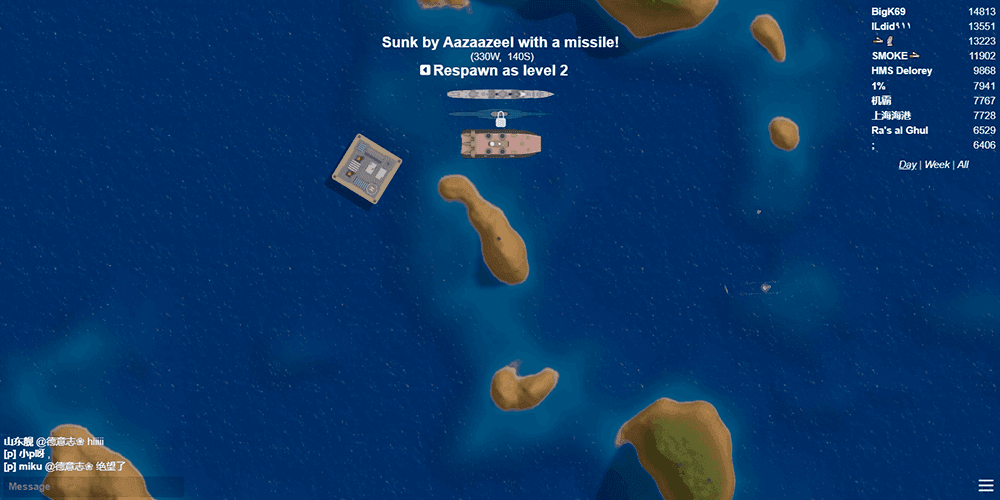
Each match is structured around a climb through ten levels, and the progression system is where the game first reveals its depth. Over 40 ships are available, each inspired by real-world vessel classes, and the roster stretches far beyond the usual battleship fantasy. Motor torpedo boats handle the early tiers with speed and fragile firepower. Corvettes and destroyers introduce heavier guns. Cruisers bridge the gap to the upper echelon, where dreadnoughts and battleships dominate with massive main cannons. Then there are the oddballs: submarines that dive beneath the surface to evade detection, hovercraft that glide across land and water alike, rams built purely for collision damage, dredgers that reshape the terrain itself, icebreakers that plow through frozen zones, and aircraft carriers that deploy squadrons controlled by your mouse cursor. Every class encourages a genuinely different playstyle, so leveling up is not just a statistical boost but a strategic decision about how you want to fight.
The weapon and sensor systems reinforce that variety. Torpedoes travel underwater and some track targets with sonar. Missiles are faster but less maneuverable. Rockets lack guidance entirely. Depth charges punish pursuers and submerged submarines, while mines linger on the map as long-term threats. SAMs counter aircraft and incoming missiles. Gun turrets offer rapid moderate damage. Aircraft act as semi-autonomous extensions of your offense. On the detection side, visual tracking, radar, and sonar each cover different conditions and target types, which becomes critical when a submarine disappears beneath the waves or a carrier's planes swarm from an unexpected angle. Combat here rewards more than good aim; it demands awareness of what you can see, what you cannot, and what tool best answers the threat in front of you.
Match Flow, Strategy, and Multiplayer Tension
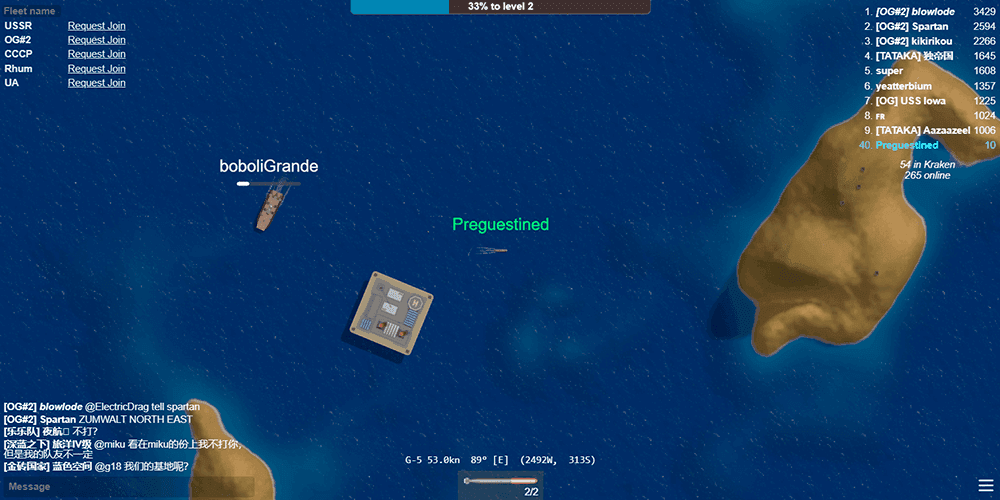
The rhythm of a typical match revolves around constant risk-reward calculations. Floating crates offer safe, steady experience, but sinking another player causes them to drop a pile of crates, making combat the fastest path to power. That mechanic alone turns every skirmish into a potential snowball. You weaken an opponent, someone else finishes them off, and suddenly three ships are circling the same loot pile with guns hot. Do you chase a damaged rival for easy pickings, or avoid the chaos and farm in quieter waters? Do you challenge a ship at your own level for a meaningful gain, or wait until the odds tilt in your favor?
Layered on top of that tension are social and environmental factors. Players can create fleets, coordinating with teammates to control sections of the map. Crowded battle zones develop organically around high-traffic areas, and the Arctic biome introduces treacherous terrain that punishes inexperienced captains. The result is a match flow that feels chaotic but never random. Survival depends on reading the battlefield, adapting on the fly, and knowing when retreat is smarter than one more volley.
Controls, Accessibility, and Overall Feel
As a browser game, Mk48.io earns points for immediate accessibility. There is nothing to download. Right-click steers, left-click fires, and the scroll wheel zooms in and out. Within seconds you are moving and shooting, which is exactly the low barrier io games thrive on. Mastery, however, is another matter. Learning weapon ranges, reload timing, sensor coverage, and the handling quirks of dozens of ships takes real investment. That gap between entry and expertise is one of the game's greatest strengths: newcomers can jump in and have fun immediately, while veterans find layers of nuance to exploit.
The overall feel is satisfying in a way that sneaks up on you. Upgrading mid-match carries a tangible thrill, especially when a new ship class completely changes your role on the battlefield. The realistic variety of the fleet keeps repeat sessions interesting, and the pressure of crowded multiplayer encounters ensures no two matches play out the same way. Some newcomers may find the battlefield overwhelming when higher-level ships start trading heavy ordnance nearby, but that initial chaos is part of the appeal once you learn to navigate it.