
Deeeep.io
Game info
Deeeep.io drops you into the ocean as a forgettable little fish and dares you to claw your way up the food chain. Within minutes you are dodging predators, hoovering up plankton, and evolving into creatures that can fight back. It is a browser-based multiplayer survival game built on a premise shared by dozens of .io titles, yet it distinguishes itself with an evolution system that actually matters, a roster of more than a hundred marine animals, and environmental hazards that keep every session tense. The loop of feeding, fleeing, and hunting never quite lets you relax, even when you have reached apex-predator status and parked yourself near the top of the leaderboard.
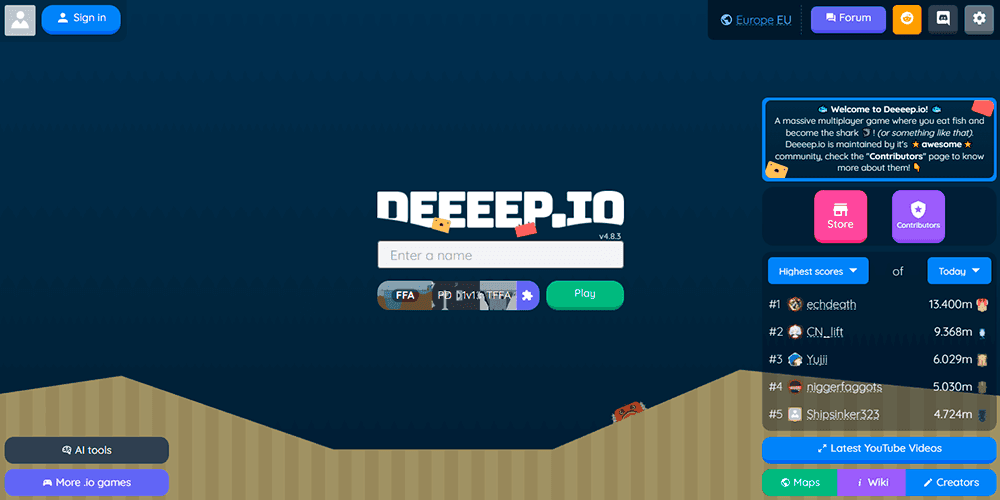
As an .io game it checks every expected box: pick a nickname, click play, and you are in a match within seconds. Controls are mouse-to-move, click-to-boost, sessions are as long or as short as you want them to be, and nothing carries over between runs. What sets Deeeep.io apart from the crowd is the depth of its ruleset. Biomes, oxygen meters, temperature sensitivity, and pressure limits all layer on top of the basic eat-or-be-eaten formula to create something surprisingly strategic for a game you can run in a browser tab.
The Food Chain as the Core Hook
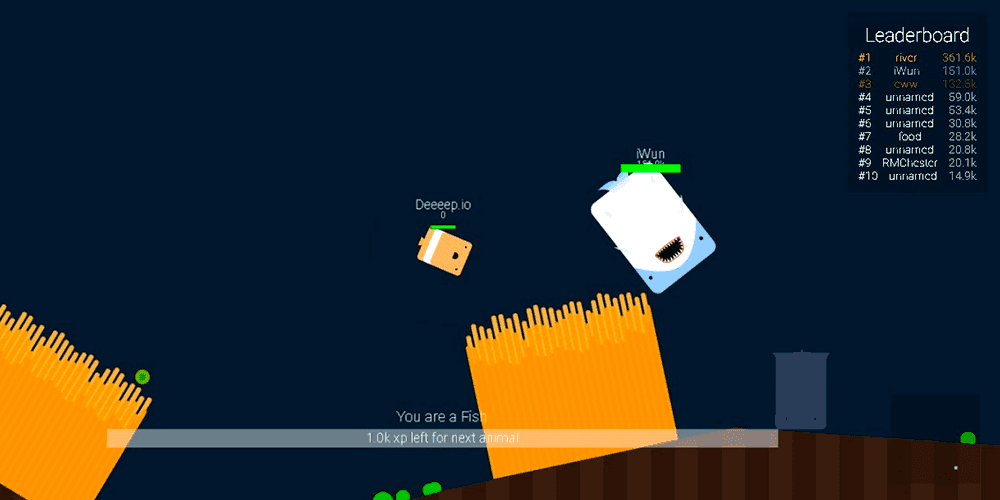
Progression is immediate and satisfying. You eat food particles, fill an XP bar, and evolve into a new creature drawn from a branching tier list that tops out at tier ten apex predators such as orcas, great white sharks, giant squids, and polar bears. Each animal comes with different stats and at least one unique ability, so every evolution choice reshapes how you play. That sense of momentum is the game's strongest quality: a single life can carry you from helpless minnow to dominant predator in just a few minutes, and the climb never stops feeling rewarding.
Where things get genuinely interesting is in the habitat system. The ocean is split into shallow waters, deep sea, arctic, and swamp zones, and each creature can only survive in specific areas. Stray into the wrong biome and warning indicators flash before your health starts draining. Temperature matters, oxygen matters, pressure matters. A clownfish that dives too deep will suffocate; a polar bear that wanders into tropical waters will overheat. These restrictions force you to plan your evolution path around where you intend to hunt, adding real strategic texture to what could otherwise be a mindless grind. The downside is that newcomers often die to environmental damage they did not see coming, and the game does very little to teach them why.
Simple Controls, High-Stress Encounters
Mouse movement and click-to-boost are as intuitive as controls get, but mastering them is another story. Combat hinges on timing your limited boosts, reading an opponent's trajectory, and exploiting terrain like rocks, coral, and narrow passages to force advantageous angles. Animal abilities add further complexity: sharks inflict bleed, jellyfish stun on contact, squids drop ink clouds for cover, and octopuses vanish with camouflage. Choosing when to spend a boost offensively versus saving it for an escape is a constant micro-decision that separates good players from great ones.
The moment-to-moment gameplay delivers genuine adrenaline. A well-timed ambush from a crocodile lurking in swamp reeds, a narrow escape through a tight gap that a larger pursuer cannot fit through, a chaotic three-way fight where the smallest creature walks away with all the XP — these moments happen constantly and keep sessions from ever feeling routine. That said, crowded encounters can become visually cluttered, making it hard to track who is hitting whom, and dying to a higher-tier player seconds before your own evolution completes is a recurring frustration that tests patience.
Variety, Fairness, and Long-Term Appeal
Replayability is strong. The massive creature roster supports wildly different playstyles — aggressive rushdown with sharks, patient stealth with octopuses, territorial control with whales that can suck in nearby prey — and both free-for-all and team-based modes keep the competitive landscape varied. Every run starts from zero with no pay-to-win mechanics in sight; skill and smart evolution choices are the only currencies that matter. Because other players are unpredictable, no two sessions play out the same way even when you follow an identical evolution path.
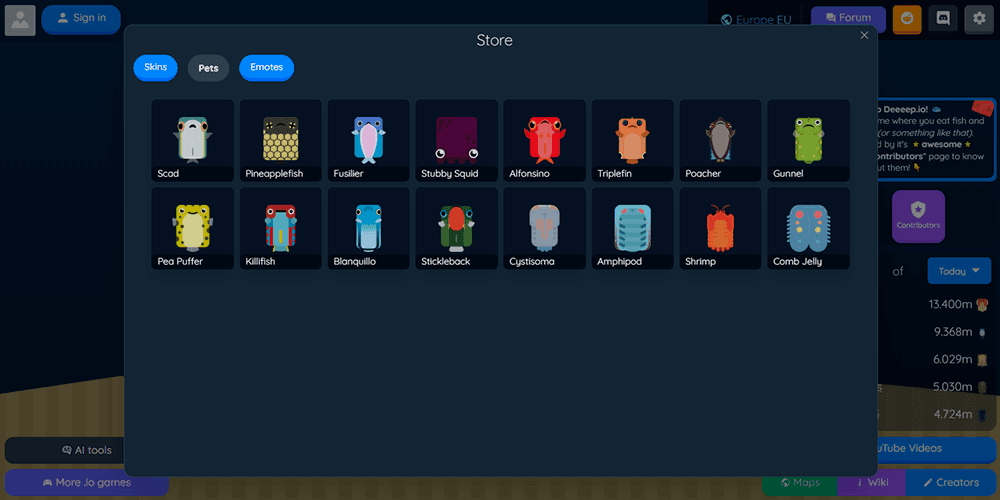
On the practical side, Deeeep.io runs well in modern browsers and loads fast, making it easy to squeeze in a session on a whim. Desktop players enjoy a clear edge over mobile thanks to precise mouse aiming, though touch controls are functional. Cosmetic skins offer light personalization without affecting gameplay balance. The game's longevity ultimately rests on how well its accessibility and strategic depth coexist, and for the most part they coexist impressively. Balance across the full creature roster is not always perfect, and the lack of a proper tutorial means new players are left to learn habitat rules and ability mechanics through painful trial and error rather than guided instruction.