
Arras.io
Game info
Arras.io is a free browser-based multiplayer tank battler widely recognized as a fan-made successor to Diep.io, built by Momentum Studios and CX and released back in November 2017. The premise is dead simple: you spawn as a weak little tank, blast colorful polygonal shapes scattered across the arena to earn experience, fight other players when you feel brave enough, and evolve into increasingly specialized killing machines as you level up. What hooks you immediately is how fast everything moves. Matches start in seconds, controls take about ten seconds to learn — WASD to move, mouse to aim, left click to shoot — and the clean, vibrant visuals keep everything readable even when the screen fills with bullets, drones, and chaos. Beneath that accessible surface, though, sits a game with genuine strategic teeth.
Tank Progression, Builds, and Combat Variety
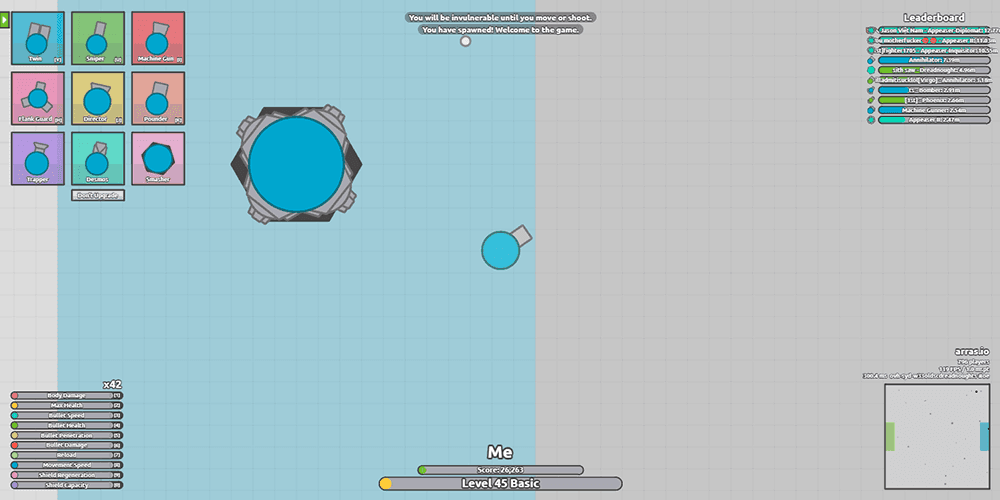
The class tree is where Arras.io truly shines. Starting from a basic tank, you hit level thresholds that unlock branching evolution paths — Twin for doubled barrels, Sniper for long-range precision, Machine Gun for relentless bullet spam, Flank Guard for rear coverage, and that is just the first fork. Push further and the options multiply dramatically. The Overseer lets you command autonomous drones. The Necromancer converts destroyed shapes into a personal swarm. The Factory spawns miniature tanks that fight beside you. The Destroyer trades fire rate for colossal single shots that erase anything they touch. With over a hundred unique tank configurations spread across the full tree, there is always another branch worth exploring.
Equally important is stat allocation. Every level grants points you distribute across eight attributes — Health Regen, Max Health, Body Damage, Bullet Speed, Bullet Penetration, Bullet Damage, Reload, and Movement Speed. A glass cannon build that dumps everything into damage and reload plays nothing like a tanky bruiser investing in health and body damage, even if both players chose the same class. This means every single run feels like a fresh experiment. You commit to a build, adapt to whatever matchups the server throws at you, and learn through hard lessons which stat spreads complement which tanks.
Combat itself feels satisfying in that deceptively simple way good arcade games manage. Movement is smooth, recoil from your own shots nudges your tank backward and can even be exploited for speed boosts, and toggling auto-fire with E frees your attention for positioning and threat assessment. The real skill gap lives in spacing, reading enemy classes, knowing when to farm passively and when to take a fight. A Sniper who maintains range dominates; a Sniper who lets an Overlord close the gap dies instantly. That kind of matchup knowledge builds over dozens of sessions and keeps the game feeling competitive long after you have memorized the tank tree.
Modes, Community, and Why the Game Keeps Pulling Players Back
Free-for-All is the default proving ground, but Arras.io stretches well beyond it. Team Deathmatch splits the server into colored factions competing for score supremacy. Domination introduces control points that demand coordinated pushes and defense. Maze mode fills the arena with walls that create chokepoints and ambush lanes, completely reshaping how classes perform. Sandbox mode removes all restrictions and lets you test max-level builds without consequences. Community-run and experimental servers push things even further with custom tanks, modified rules, and beta features. Each mode shifts the rhythm enough that a class feeling underwhelming in one context can become dominant in another, which keeps experimentation alive.
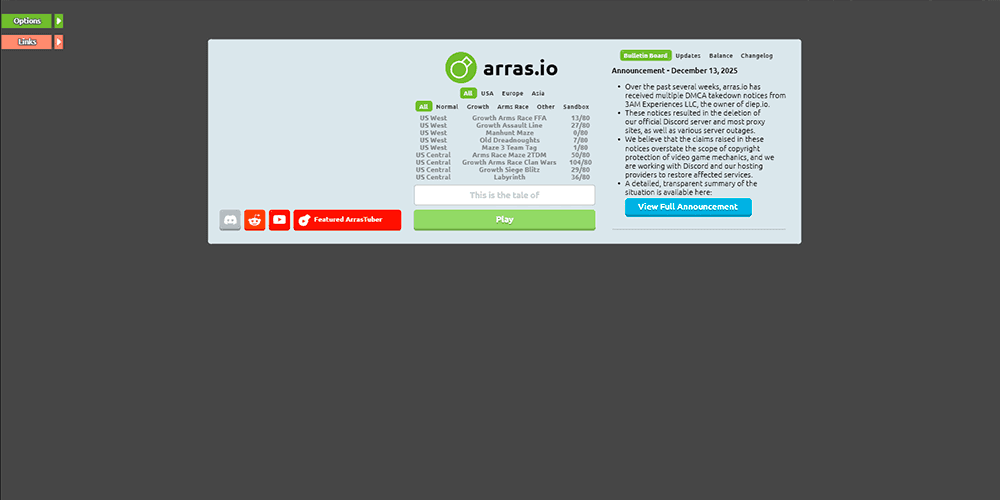
Accessibility is a huge part of why Arras.io endures. There is no download, no account creation, no paywall. You open a browser tab, pick a server, and you are playing. It runs on virtually any hardware, works on mobile in a pinch, and the lightweight HTML5 engine keeps lag manageable even on modest connections. Around the game sits a dedicated community trading strategies on Discord and Reddit, maintaining tier lists, chasing leaderboard records, and debating the meta after every balance patch. The development team still rolls out updates, new tank classes, and seasonal tweaks, so returning after a break almost always means discovering something fresh. Between the depth of the class system, the variety of modes, and the zero-friction entry point, Arras.io has built the kind of staying power most browser games can only dream about.